


Wearable Amplifiers (VoiceMate™)
Clip-On / Hands-Free (VoiceFree™)
Classroom Systems (VoiceEqual™)
View All Voice Amplifiers👈
🎓Teachers & Educators
🧭Tour Guides & Outdoor
📊Corporate Trainers
🧘Fitness & Yoga Coaches
🎥Content Creators & Streamers
⛪Faith & Missionaries
📣Community & Events


WinBridge S20 Wireless Handheld Microphones for S200, K400 Portable Pa Speaker System ( 2-Pack )
$69.00


WinBridge 2.4GHz Wireless XLR Microphone Transmitter & Receiver System - 24-bit/192kHz High-Resolution Plug-on Adapter for Dynamic Microphones, Audio Mixers, PA Systems, and Cameras H58
$89.99


WinBridge A4 Quick-Dry Thermal Printer Paper 25 Rolls, Compatible with Portable Printer, 8.27"x11.69"(210mm*297mm)
$105.99


WinBridge Aluminum Alloy Laptop Stand with 6-in 1 USB C Hub for Desk, 4K HDMI, 2 USB 3.0, 100W PD Charging, Stable & Ventilated, Adjustable Height, Fits All MacBook, Laptops up to 15.6 inches
$149.99


Voice Amplifier for a Strained or Damaged Voice: Why Hands-Free Beats Speaking Louder
If your voice is worn out by the end of the day — hoarse, tired, or still recovering — the natural instinct is to push harder to be heard. That is exactly what makes it worse. A hands-free voice amplifier flips the problem around: it lets you be heard clearly while you speak softly, so your voice does far less of the work.
This matters most for people who are on their voice all day — teachers, trainers, tour guides, coaches, phone-heavy roles — and for anyone trying to rest a strained or recovering voice. The goal here isn't more volume for its own sake; it's less vocal effort. Below is how to choose and use a voice amplifier so your throat can ease off.
A quick note: this is practical buying and usage guidance, not medical advice. A voice amplifier can reduce how hard you work to be heard, but it doesn't treat a voice condition — if you have persistent hoarseness, pain, or vocal-cord damage, please see a doctor or speech-language professional.
Why "just speak louder" is the wrong fix
Raising your voice to fill a room means pushing more air through your vocal cords, over and over, for hours. For a voice that is already tired or sensitive, that repeated effort is the problem, not the solution. Amplification removes the reason to push: with a microphone close to your mouth and a speaker carrying the sound, you can talk at a relaxed, almost conversational level and still reach the back of the room. The volume comes from the amplifier — not from your throat.
The one principle: let the amplifier carry your voice, not your throat
Everything about choosing the right setup comes down to this: the closer and more consistent the microphone sits to your mouth, the softer you can speak and still be picked up clearly. That is why a worn, hands-free mic beats a handheld for anyone protecting their voice — it keeps the mic at a fixed, close distance so a quiet voice is captured and projected, and it frees both your hands so you aren't tensing your neck, shoulders or posture while you talk.
Which setup strains your voice least
Here is how the main WinBridge options compare specifically for low-effort speaking — not for maximum loudness.
| M801 (headset) | WB005 (lapel) | S98 (bigger rooms) | |
|---|---|---|---|
| Mic type | UHF wireless headset | Lavalier / lapel clip-on | UHF wireless mic + headset |
| Vocal effort | Lowest — mic sits closest to your mouth | Low — clips at the collar | Low with the headset mic |
| Hands-free | Yes | Yes | Yes (headset mic) |
| Wearability | Over-ear headset | Clips on, very light & discreet | Portable unit, carry it |
| Power | 20W | 15W | 50W |
| Best for | All-day teaching, lowest effort | Discreet presenting & meetings | Larger rooms & outdoor groups |
| Price | ~$99.99 | Confirm on page | ~$129 |
Headset: the lowest-effort choice
For the softest speaking and the longest days, a headset wins. Because the mic stays a couple of centimetres from your mouth no matter how you move, it captures a quiet voice consistently, so you never have to lift your volume to "reach" it. The hands-free WinBridge M801 is built around exactly this.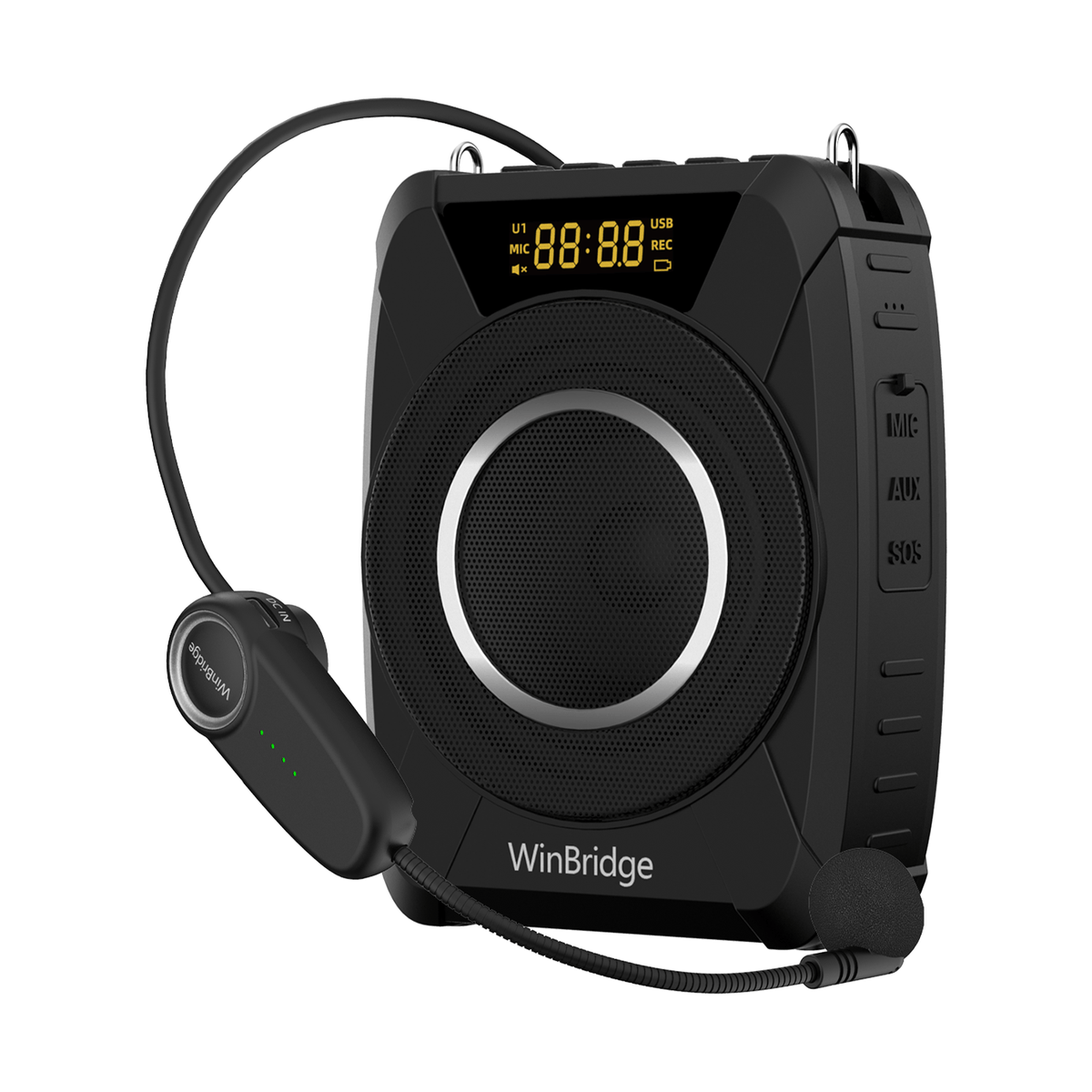
Lapel: light, discreet, still hands-free
If a headset feels like too much to wear, a clip-on lavalier is the lightest way to stay hands-free. It sits at your collar, out of sight, and still lets you speak at a low, relaxed level. The WinBridge WB005 is a compact lapel-mic option popular with teachers and presenters.
Bigger rooms, same soft voice
In a large classroom, gym or outdoor group, you may simply need more carrying power so you still don't have to push. A higher-output unit like the 50W S98 — used with its headset mic — keeps you hands-free and lets a soft voice fill a bigger space.

How to use it so your voice actually rests
The device only helps if you let it do the work. A few habits make the difference:
- Keep the mic close. A headset mic sits best a couple of centimetres from the corner of your mouth — close enough to catch a near-whisper.
- Set the volume, then speak softly. Turn it up until a relaxed, low voice fills the room, and resist the urge to add your own volume on top.
- Go hands-free. A headset or lapel frees your hands so you're not hunching or tensing while you talk.
- Take voice breaks and hydrate. The amplifier lowers your load; pairing it with rest and water helps even more.
Buying checklist for a low-effort voice
- Choose hands-free first. A headset or lapel mic beats a handheld for protecting your voice.
- Prioritise close mic placement. The closer the mic, the softer you can speak — headset closest, lapel next.
- Match power to your room, not your effort. Let more watts cover a bigger space so you never have to raise your voice.
- Look for all-day battery. You want it to last a full teaching or working day without a mid-day charge.
- Keep it light and wearable. Something comfortable enough that you'll actually wear it every day.
Frequently asked questions
Can a voice amplifier help if I have damaged vocal cords?
It can reduce how hard you work to be heard — letting you speak softly while the amplifier carries the volume — which eases the strain of talking all day. It is not a medical treatment, so for damaged vocal cords, see a doctor or speech-language professional and use amplification as support, not a cure.
What's the best voice amplifier for a weak or soft voice?
A hands-free model with a close-fitting mic. A headset keeps the mic nearest your mouth, so even a quiet or weak voice is picked up clearly and projected without you having to push.
Is a headset or a lapel mic better for vocal strain?
A headset strains your voice least because the mic stays closest and most consistent. A lapel mic is lighter and more discreet, and still lets you speak at a low, relaxed level — a good choice if a headset feels like too much to wear.
Can teachers use a voice amplifier to avoid losing their voice?
Many do. Teaching is one of the most vocally demanding jobs, and amplifying a relaxed speaking voice reduces the daily load of projecting across a classroom. It's a common, practical way to get through back-to-back lessons with less effort.
How loud should I set a voice amplifier?
Only as loud as it takes to be heard while you speak at a relaxed, low level. The point is to lower your effort, not to maximise volume — set it so the room hears you without you pushing at all.
Will a voice amplifier fix my hoarseness?
No — it reduces the strain of speaking, but it isn't a cure. If hoarseness lasts more than a couple of weeks, or comes with pain, see a doctor; use an amplifier alongside their advice to lighten your vocal load.
The bottom line
If your voice is tired or sensitive, the most useful change isn't speaking up — it's letting a device do the projecting for you.
If you remember three things:
- Don't push harder — amplify. Let the speaker carry the volume so your throat doesn't.
- Hands-free with a close mic is lowest-effort. Headset is closest; lapel is lightest.
- It reduces strain — it's not a cure. See a professional for a voice condition, and use amplification as support.
For the lowest daily effort, the hands-free M801 is the place to start; for something lighter and more discreet, the WB005 lapel; for bigger rooms, step up in power. Browse the full range of WinBridge voice amplifiers to find the one you'll be comfortable wearing all day.
About the author. Written and tested by the WinBridge audio team — we build voice amplifiers and portable PA systems and work with teachers and all-day speakers every week. This article is general product guidance, not medical advice.
- Choosing a selection results in a full page refresh.

!